Monday, August 31, 2009

3 Florida WASP honored in Miami


3 female pilots honored for service during World War II

3 SOUTH FLORIDA WOMEN RECEIVE RECOGNITION FOR SERVICE DURING WORLD WAR II

VDIDZIULIS@MIAMIHERALD.COM

August 28, 2009


After decades of taking a back seat to their true legacy as skilled pilots and gender barrier pioneers, these female pilots finally received the recognition they deserved:

The Congressional Gold Medal.

``I'm just overwhelmed,'' said Frances Rohrer Sargent, 90. ``We didn't do it to get that. We just liked to fly.''

Sargent was joined by Ruth Shafer Fleisher, 87, at Saturday's ceremony at Wings Over Miami Air Museum in which U.S. Rep. Ileana Ros-Lehtinen presented the three South Florida pilots with original copies of the bill honoring the WASPs signed by President Barack Obama this summer.

The third pilot, Helen Wyatt Snapp, 91, was recovering from an illness and did not attend the ceremony.

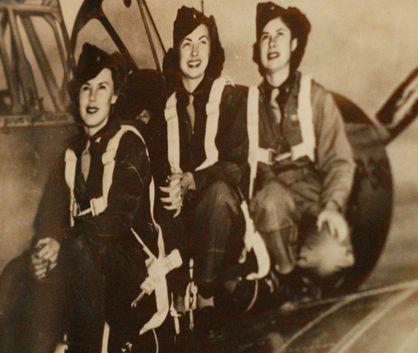
The women were part of the first group of female pilots ever to fly war planes. Although they flew non-combat missions, their service was deadly: 38 female pilots died while protecting U.S. coasts from enemy invasions.

Yet their patriotic contributions went largely unrecognized for decades. They weren't eligible for U.S. veterans' status until 1977 and they were never awarded full military status.

300 STILL ALIVE

Only about 300 original WASPs are alive today, most of them well into their 80s.

Ros-Lehtinen, who along with other female lawmakers pushed the legislation forward, said the WASPs now join the ranks of the Navajo Code Talkers and the Tuskegee Airmen, who at the time of their service were discriminanted against because of their race.

``What's most inspiring is knowing that they never did it to break any barriers or change histroy,'' Ros-Lehtinen said. ``They just loved to fly and wanted to do so in defense of our country.''

STARTED AT 13

Sargent and Fleisher didn't just like to fly, they were born to fly.

Fleisher, the daughter of an airplane mechanic who later managed an airport in Rochester, N.Y., started logging flights as early as age 13. She said she flew ``anything she could.''

During her service, Fleisher tested AT-6 warbirds. After the WASPs were disbanded in 1944, she got a commission to join the Air Force as second lieutenant and retired in the Air Force Reserve as a major. She later became one of the first women to work in a control tower at Philadelphia International Airport.

Sargent started piloting in her early 20s in her native Little Rock, Ark., but once she caught the flying bug she didn't stop until well into her 70s.

During the war, Sargent flew along North Carolina's shores, on the lookout for enemy ships, submarines and planes. She later joined the Air Force Reserves and spent 30 years teaching aviation at Miami Dade College.

One of her students, 68-year-old Judy Portnoy, called Sargent ``the most amazing person I know.''

Both Fleisher and Sargent moved to South Florida about four decades ago.

Fleisher manages a three-acre avocado grove in Homestead and Sargent lives in a retirement home in Old Cutler Bay.

BOTH WIDOWED

They were both married and later widowed. Sargent has three children.

Growing up in a time when jobs for women were often limited to office jobs, nursing and teaching, Fleisher and Sargent are aware they were trailblazers.

``It was hard because people didn't think about women flying,'' said Sargent. ``But we didn't care, we did what we wanted to do.''

Fleisher agreed and said they proved all their doubters wrong.

``We, as some of the first women pilots, proved that we could fly military airplanes and do a good and decent job,'' Fleisher said.

Winged victory

WWII female pilots getting long-overdue recognition

UNION-TRIBUNE STAFF WRITER

2:00 a.m. August 30, 2009

For Joyce Secciani, who used to dream about flying, it was as if it was in their blood. And being part of the WASP during World War ll was an ideal way for them to do what they loved most. (Laura Embry / Union-Tribune) -
For Vivian Eddy, who used to dream about flying, it  was as if it was in their blood. And being part of the WASP during World War  ll was an ideal way for them to do what they loved most. (Laura Embry /  Union-Tribune)

For Vivian Eddy, who used to dream about flying, it was as if it was in their blood. And being part of the WASP during World War ll was an ideal way for them to do what they loved most. (Laura Embry / Union-Tribune)

Joyce Secciani also expressed her love of flying through her art talent, sculpting and bronzing wooden figurines of a WASP pilot. (Laura Embry / Union-Tribune)

Joyce Secciani also expressed her love of flying through her art talent, sculpting and bronzing wooden figurines of a WASP pilot. (Laura Embry / Union-Tribune)

Vivian Eddy, shown coming out of a Bell P-63 Kingcobra, received an American Campaign Medal, awarded to the WASP in 1977.

Vivian Eddy, shown coming out of a Bell P-63 Kingcobra, received an American Campaign Medal, awarded to the WASP in 1977.


Photo of Ozzie Roberts

Call Ozzie at 619-293-2037

Email Dean

Bio Page


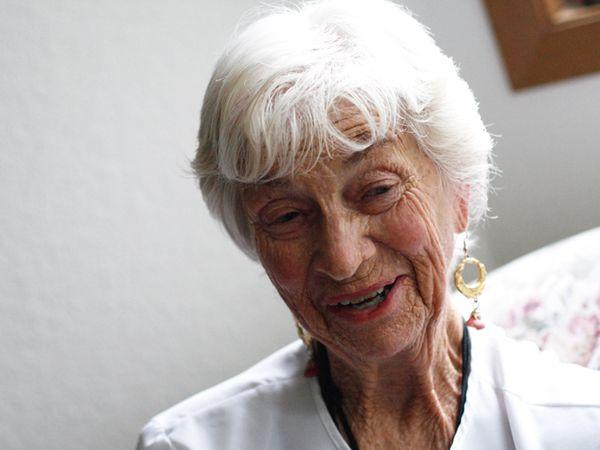
At 88, Vivian Eddy still rails loudly about the disbanding of the WASP (Women Airforce Service Pilots). It was a program through which she and more than 1,000 other women made a lasting if little-mentioned mark on World War II and U.S. combat aviation.

“I thought it was the nastiest thing they (Army Air Forces officials) could have done to us,” Eddy says while receiving visitors at her home in Coronado. “They fired us. They gave our jobs to Air Force men who didn't want to go overseas. I would have gone overseas in a minute — I was a (heck of) a good fighter pilot.”

Joyce Secciani, at home in El Cajon, is calmer on the subject. But despite a fading memory, at 87 she still shares Vivian's passion for the WASP and her disappointment with its demise. She, like Vivian, was one of the 1,102 women who flew in the all-volunteer program between 1942 and 1944.

“All of us felt bad to lose (our flying jobs) — all of us wanted to keep up our ability to fly,” Secciani says. Because they knew that with prevailing chauvinistic attitudes, there would be no pilots' work for them in the civilian realm.

But a small triumph has been wrought for the legacy of the WASP. Last month, , President Barack Obama signed into law a bill that awards the Congressional Gold Medal to Women Airforce Service Pilots.

The award — Congress' highest civilian honor — recognizes the women's contributions during the war, and a Capitol celebration, including individual medal presentations to surviving WASPs, is being planned.

Author Amy Goodpaster Strebe, who has become almost obsessed with getting WASP pilots a fair representation in history, is visiting and talking up the award with Eddy and Secciani.

Goodpaster Strebe, a native San Diegan, became an avid supporter while doing her research a couple of years ago on her recently published book — “Flying For Her Country” — which reports the history of the WASP program.

The pilots, she says, were much more than the first women to fly American military aircraft. They did everything their male counterparts did except fly in combat.

They risked their lives, some — 38 of them — even gave them up. And in the end, amid a lot of politics, they were unceremoniously dismissed and kept a secret in classified archival files for more than 35 years.

Goodpaster Strebe joined with support organizations, such as Texas-based Wings Across America*, which is dedicated to preserving the WASP legacy and spearheaded a national campaign that led to the congressional medal.

She has met and talked with dozens of surviving WASP members around the country.

“Knowing what I now know about the WASP and meeting them,” she says, “made me want to get the word out about them.”

But now she sits near a table, gripped by Secciani's calm recounting of walking away from a fiery crash landing in her hometown of El Centro nearly 70 years ago.

“The ship skidded on the runway and the engine started sputtering,” Secciani says. “I was anxious when I saw the plane catching on fire, but I'd always had faith in planes and the guys who were taking care of them. So I always felt confident that I was going to get out safely.

“I loved flying,” she adds. “I used to dream of just stretching my arms out and flying.”

She says that love and fearlessness made her sign up without hesitation for the WASP when she heard about the program in January 1943.

“We all just wanted to fly,” she says wistfully.

Eddy recalls that she was two WASP classes behind Secciani and they didn't meet until six years ago, when they got together to compare pictures and other memorabilia.

Eddy agrees eagerly that all the WASP pilots wanted to do was fly — “not so much prove anything to anybody, but just fly.”

“When I was in fourth grade, my granddad took me to an air show and I saw women flying in the show — that got me hooked.”

Eddy was a WASP ferry pilot, who crisscrossed the country at least nine times, flying fighter planes from their manufacturers in Los Angeles to air bases in Newark, N.J., and Great Falls, Mont.

“I could fly any plane the (Air Force) had,” she says, before noting that after the war, the closest to a professional flying job she could get was as a stewardess with one of the major carriers.

“They knew I could fly their planes,” she says. “But they wouldn't let me, because they said it wasn't right for women to fly (professionally). Isn't that terrible?”

Shortly before her visit ends, Goodpaster Strebe notes that researchers figure there are only maybe about 300 WASP survivors left and it will be most appropriate for them to get the congressional medal and the recognition after so long.

Says Eddy, softening: “It's nice to finally be recognized — it's never too late.”

Union-Tribune

Ozzie Roberts: (619) 293-2037;


**Edited for accuracy

Friday, August 21, 2009

The Sky's the Limit

August 20, 2009

Thursday, August 20, 2009

WASP Cuts the Ribbon at L 3


Cutting the ribbon: Gordon Collins with Rubb Building Systems, TSTC Waco President Elton Stuckly, Chamber President/CEO Jim Vaughn, Camber Senior VP of Economic Development Sarah Roberts, WASP Deanie Parrish, City Manager Larry Groth and Mayor Virginia DuPuy.

Waco, Texas Monday, August 17, 2009

A new ten-million dollar hangar was officially opened at a ribbon cutting ceremony today at L-3 Integrated Systems in Waco, Texas .


L-3 invited Waco resident WASP Deanie Bishop Parrish to cut the ribbon celebrating the official opening of their new hangar, —87, 000 square feet of state-of-the-art space, which will house four C130's or P-3 aircraft and many smaller sized aircraft. It was constructed by Rubb Building Systems of a composite fabric, allowing for faster construction at a lower cost and providing a very bright work environment. L-3 Communications is the 6th largest defense company in the United States.


L-3 Platform Integration President James Burkhardt presents WASP Deanie Parrish with the division’s president’s coin, a military style challenge coin awarded to high-performing employees and distinguished visitors.


Deanie has a unique 'historical connection' to L-3. She is one of 1100 pioneering female pilots of World War II known as WASP, Women Airforce Service Pilots, the first women in history to fly America’s military aircraft. As a WWII Army Air Force trained Martin Marauder B-26 pilot, Deanie trained to fly instrument on what she calls, "The Blue Box," which is an early flight simulator invented by Ed LINK. This "Link Trainer" was used to train ALL Army Air Force pilots during WWII, and is a colorful part of L3's long history in aviation, setting the standard in aviation training and flight simulation for 80 years.

During her visit, Deanie was also warmly welcomed to the USAF 661st Aeronautical Systems Squadron and was given an opportunity to meet some of the Air Force personnel attached to the squadron and share a short history of her service as a WASP during WWII.


USAF Captain Jeremy Smith welcomes WASP Deanie Parrish to the 661st Aeronautical Systems Squadron

As the result of recently passed legislation, which was signed into law on 1 July 09 by the President of the United States, more and more WASP are being honored across America. Public Law 111-40 will soon honor the service of Deanie and the other WASP with the Congressional Gold Medal, the highest award the Congress can bestow on a civilian. The medal ceremony will be held in the US Capitol, at a date to be determined, following the designing and 'striking' of the gold medal by the US Mint.

Links to more information:

respectfully submitted, August 20, 2009

Monday, August 17, 2009

Honor for High Service--WASP Kathryn Miles

Appeared in print: Monday, Aug 10, 2009

News: Last Seven Days: Story

Of the nearly 1,200 women who first flew U.S. military aircraft in World War II, fewer than 300 are living. Eugene resident Kathryn Miles, 88, is among them.

Miles and her fellow servicewomen compose a group called the Women Airforce Service Pilots, known as WASPs, which will receive congressional honors after the Senate passed a bill last month to award the women the Congressional Gold Medal for their under-recognized service.

The women who joined the WASPs in 1942 and 1943 did so with the understanding that they would receive full military status and the benefits that came with it when they entered training. Under the direction of the U.S. Army Air Forces, they combined to fly more than 60 million miles on nearly every type of military aircraft and completed every type of mission except direct combat. Among their duties were ferrying new planes from factories to military airfields or towing targets used in anti-aircraft artillery practice.

However, they weren’t afforded active military status. The families of the 38 women who died in service had to pay to fly their bodies home.

“I just accepted that a lot of people had a prejudice against women,” Miles said.

WASPs weren’t acknowledged as a full-fledged military group until 1977, after which Miles struggled to obtain a Veterans Administration loan.

By the time she could have received the loan, she and her husband already had secured funds.

For Miles, the recognition from Congress is hardly too little, too late. The WASPs made a major contribution to generations of servicewomen, she said, and the honor is validation.

“It’s not just that we were successful, which we were, but we paved the way for the women who are in the armed services today,” she said. “It’s lovely that the Senate decided we should be recognized.”

Sen. Ron Wyden will visit Miles’ home on Tuesday to present her with a framed copy of the legislation awarding the medal to WASP members and a U.S. flag.

The awards ceremony in Washington, D.C., where the remaining women will receive their medals before Congress, hasn’t been scheduled yet, but Miles hopes it’s soon. When you get to be the age of the WASP women, you can’t count on how long you’ll be around, she said.

Two of Miles’ comrades — a close friend and one of her roommates from her service days — have died this year.

“It’s very painful when people die this close to the award,” she said.

Only one real medal will be made and it will be housed in the Smithsonian Institution. Miles said the women will receive individual bronze replicas.

Miles’ four children and some of her grandchildren also will attend the ceremony, she said.

After the war, Miles mostly retired from flying. She married in Alaska and moved to Eugene for the region’s natural beauty.

She worked as a teacher and counselor in the Bethel School District.

Miles has fostered friendships with a number of WASP members over the years. Of her winged sisters she said, “We all have a common purpose to inspire young people in aviation.”

65 years later, female WWII test pilots finally recognized


by Madeleine Baran, Minnesota Public Radio,
Nikki Tundel, Minnesota Public Radio
August 13, 2009

St. Paul, Minn. — When Elizabeth Strohfus looked into the sky above her hometown of Faribault, Minn., during the height of the Great Depression, she saw a future that didn't involve working at the city clerk's office and struggling in poverty. She saw the clouds and the open air, and she wanted to be up there.

"It began as a young gal trying to climb as high as I could," she said. "I had that feeling that I wanted to get higher."

Strohfus went to the bank, and took out $100 to join a local flying club. She left behind her bicycle as collateral, and headed into the air.

After the Japanese bombed Pearl Harbor, she quit her job and signed up for the newly formed Women AirForce Service Pilots, where she became one of the first women in the United States to fly military planes.

The story of these women, known as WASP, remains largely unknown. They flew the biggest bomber planes. One of the planes they flew, the Martin B-26 Marauder, was so dangerous that it became known as "The Widowmaker." They even attached a long piece of canvas to the back of their planes to allow men to practice hitting targets -- with live ammunition.

A famous female pilot, Jackie Cochran, spearheaded the effort. The military agreed to create the program in 1942, when they realized it would free up male pilots to go to war. The WASP flew in the United States, since Congress refused to send them into combat or recognize them as official members of the military.

Last month, President Obama signed a bill to give the WASP the Congressional Gold Medal, the highest award for civilians. President Carter had previously granted the WASP veteran status.

Strohfus and another Minnesota WASP, Mildred "Micky" Axton, will travel to Washington DC in a few months to receive their medals.

Sixty-seven years ago, Axton and Strohfus loaded up their suitcases, unsure of when they would return, and headed for Avenger Field in Sweetwater, Texas. About 25,000 women applied for the program, and 1,800 were chosen.

Axton, 90, recounted her story on a recent afternoon at her Eden Prairie apartment, her walls covered with framed WASP-era photos, her carpeted floor blanketed with cardboard placards pasted with war memorabilia.

Unlike Strohfus, Axton had graduated from college with degrees in math and science. She vividly remembers her first flight as a licensed pilot in Coffeyville, Kan. Her great-grandmother insisted on being her first passenger.

"She said, 'Tip it over, Micky, so I can see better,'" Axton said, laughing. "I said, 'If I do that, we'll get killed.' That settled that."

When her brother left to fight in the Pacific front, Axton felt like she couldn't stay home. "There was no way to keep me from going," she said.

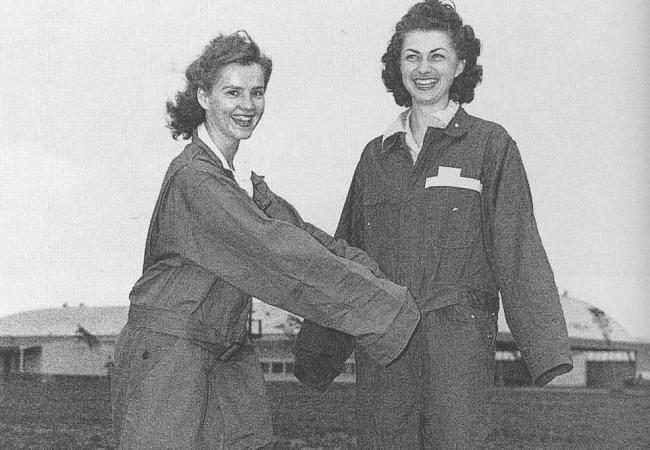
Axton and Strohfus left for Texas, where they lived in military barracks and wore uniforms discarded by male pilots.

"They were big," Strophus, 89, remembered. "Yank 'em up, roll up 'em, we didn't care. We wanted to fly airplanes."

The heat was sometimes unbearable. One night, Axton and her roommates decided to escape the stuffy barracks and sleep outside, but they quickly returned to the barracks after encountering a rattlesnake.

There were many close calls in the air. The WASPs acted as test pilots for aircraft that had been repaired after being damaged in combat. It was a job that didn't have many male volunteers, but the WASP agreed to take on any job that allowed them to fly.

Axton told a story of a time she was flying a repaired twin-engine B-25 bomber, with a male co-pilot who sat behind her.

"We took off and it didn't act right," she said. "I knew it was trouble, and I called the tower and told them I had to bring it in."

The engine was quickly failing, and ambulances rushed to the scene. The male pilot started crying. "He thought he was going to get killed," she said.

Axton managed to bring the plane in. "I was a little shook up, but I was tickled to pieces that I brought it in and didn't hurt anything. It was a nice landing."

Her co-pilot did not share Axton's glee. He was removed from the plane by a medical team and carried away in an ambulance, sobbing.

The military knew that the WASP would fly any plane, but male pilots had preferences. Rumors circulated about the dangers of certain planes, and the military asked the WASP to shame the men into flying them. If a woman could fly a particular plane, the thinking went, so could a man.

This was how Strohfus ended up flying a "Widowmaker," the B-26. The heavy plane had a short wingspan, which required pilots to land the plane at a dangerously fast speed.

"Taking off or landing it was pretty iffy," Strohfus said. "So you had to be careful. You could crash very easily, but I thought it was great. Once you got it in the sky, it was a great plane to fly."

In between flying, the WASP cultivated a unique culture, complete with their own mascot named Fifi, a female cartoon character sporting wings and blue flight goggles. On their way to the runway, the WASP marched through the barracks, singing.

At a recent air show, Strohfus stood behind a booth commemorating her service, and eagerly broke into song, to the tune of Yankee Doodle Dandy:

"We are Yankee Doodle Pilots, Yankee Doodle, do or die! Real, live nieces of our Uncle Sam, born with a yearning to fly. Keep in step to all our classes, March to flight line with our pals. Yankee Doodle came to Texas just to fly the PTs! We are those Yankee Doodle Gals."

But the mood was not always so upbeat. One night, Axton stood next to the runway, getting ready to fly, when she looked up into the sky, just in time to see a plane descend rapidly and crash a few hundred feet in front of her.

Several of the WASP started to cry, but they were ordered to fly that night, or else leave the program.

"We saw it happen," Axton said. "We were right there waiting to fly. Can you imagine?"

The pilot who died that night was one of 38 WASPs killed while flying. Another was Axton's close friend and roommate, Gertrude Tompkins-Silver. She took off in a P-51 fighter and crashed into the Santa Monica Bay in California. Her body was never recovered.

When WASP died, the military refused to pay to send their bodies home, or provide a military funeral. Instead, the women took up collections for the families to cover the costs.

"They never did get a proper burial," Axton said. "The families had to bury them themselves. That's how those men in Congress were then."

The military disbanded the WASP program in 1944, before the war ended, and sent the women home. Military officials said they had enough pilots, as fewer male pilots had died in combat than expected.

A letter sent to the WASP said, in part, "You have freed male pilots for other work, but now the war situation has changed and the time has come when your volunteered services are no longer needed."

Axton went on to have a successful career at Boeing, and eventually moved to Minnesota. The news hit Strohfus much harder.

"When I got out, no one wanted a woman pilot," she said. "I went to Northwest Airlines and showed them my credentials. I had sea plane, I had a commercial rating, and I had 1,000 hours of flying time. They were very impressed. They surely would like me in their front office. I told 'em what they could do with their front office."

The rejection stung. "I wanted so badly to be out flying that it kind of broke my heart, but that's OK, because that was the way it was."

After the war, "nobody wanted to hear about women pilots," Strohfus said. "They didn't even know we existed. I had everything in my closet, my uniform, my pictures, my books. I told the kids, 'When I die, put it in my coffin.'"

But when the Air Force allowed female pilots to start training in 1976, Strohfus started going to air shows and schools to tell her story.

When she was 72 years old, she asked the military if she could fly the F-16 as a co-pilot. Her request was granted, and she flew with a male pilot over the skies of Duluth. She took over the controls mid-flight.

"I said, 'I'll just do a gentle turn,'" she said. "I did 6 Gs. He said, 'Take it easy. I don't have a brown bag.' I said, 'You can take mine. I don't need it.'"

Strohfus said she's glad to finally receive recognition for her achievements, but then she paused, grinned, and said, "The award is nice, but heck, I just like to fly airplanes."